

AI governance services for every stage
From first idea to fully regulated operation. Right-sized governance at every step of your AI journey
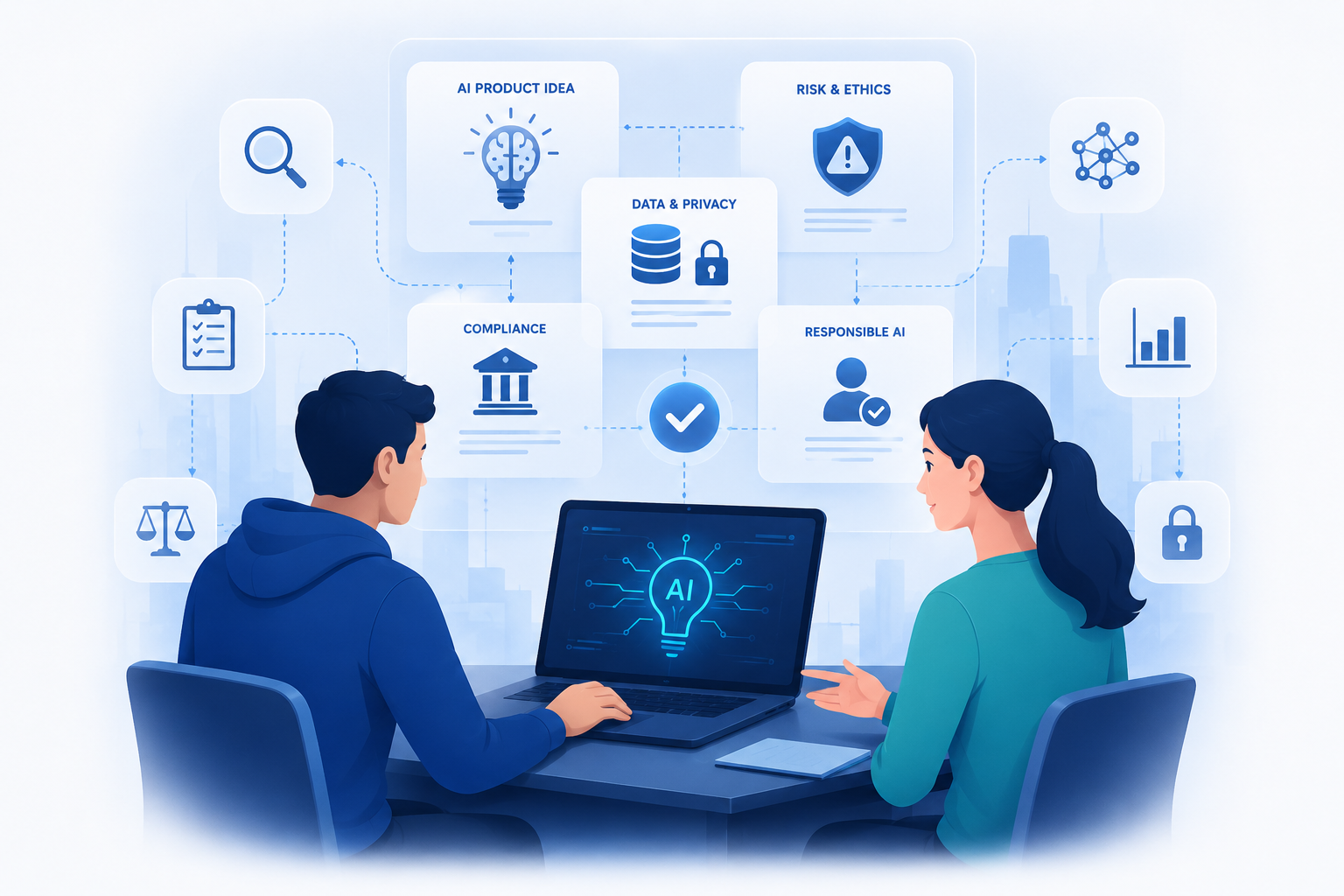
Stage 01 — Idea Stage
Idea-Stage AI Founders
Early concept or prototype phase. Understand your risks before you build further.
No awareness of what AI-specific risks your use case carries
Unclear data usage boundaries — what you can and cannot collect, store, and use
Potential misuse scenarios you have not considered
Ethical exposure — bias or harm baked into the concept before a line of code is written
AI Idea Risk Scan
A structured review of your AI product concept against known risk categories — regulatory, ethical, data, and commercial. We identify the risks your idea carries before you invest in building. You receive a written risk summary and a go / proceed-with-caution / restructure recommendation.
Use Case Risk Mapping
A detailed mapping of your intended AI use cases against regulatory frameworks including the EU AI Act risk classification system. We identify whether your use cases fall into prohibited, high-risk, limited-risk, or minimal-risk categories — and what that means for how you build
Basic Data Strategy Advisory
A focused advisory session covering what data you plan to use, how you plan to collect it, and what the privacy and compliance implications are. We identify data strategy decisions you need to make before you build — not after.
High-Level AI Architecture Risk Guidance
A review of your proposed AI architecture — models, data flows, integrations, deployment approach — from a governance and risk perspective. We flag architecture decisions that create compliance problems or liability exposure before they are built in.
Outcome
Clarity on the risks your AI idea carries before you commit to building. Make informed architecture, data, and use case decisions from the start.
1–2 weeks depending on complexity of use case
Stage 02 — MVP & AI Agent
AI Agent & MVP Builders
Prototype or AI agent already built. Make it safe before you launch.
Unsafe to launch — you do not know what the product will do at edge cases or under adversarial use
Hallucination and unpredictable AI behaviour — especially for AI agents taking autonomous actions
Data leakage and misuse risks — user data, personal information, confidential inputs
Open-source licensing concerns — are you using models and code in ways that comply with their licences
AI Agent Risk Audit
A comprehensive risk assessment of your AI agent — covering autonomous action scope, failure modes, hallucination risk, data handling, accountability gaps, and human oversight. Written audit report with specific findings and recommended fixes before launch.
Pre-Launch Safety Review
A structured review against a pre-launch safety checklist covering output safety, data privacy, user harm scenarios, edge case behaviour, and basic incident response. Pass / fail rating with remediation guidance for any failures.
Open-Source Compliance Check
A review of every open-source model, library, and dataset your product uses. We check licence compatibility, usage restrictions, commercial use permissions, and attribution requirements.
Data Handling Risk Assessment
A focused assessment of how your product collects, processes, stores, and transmits data. We identify privacy compliance gaps, consent issues, and cross-border data transfer risks under GDPR, India's DPDP Act, and other applicable frameworks.
AI Behaviour Testing Scenarios
Development and execution of structured adversarial and edge case test scenarios. We test for harmful outputs, jailbreak vulnerability, demographic bias, hallucination patterns, and unexpected refusals. Testing report with findings and recommended guardrails.
Outcome
Your AI product is safe for controlled launch. You know what it does, what it does not do, and what guardrails are in place.
2–4 weeks depending on product complexity
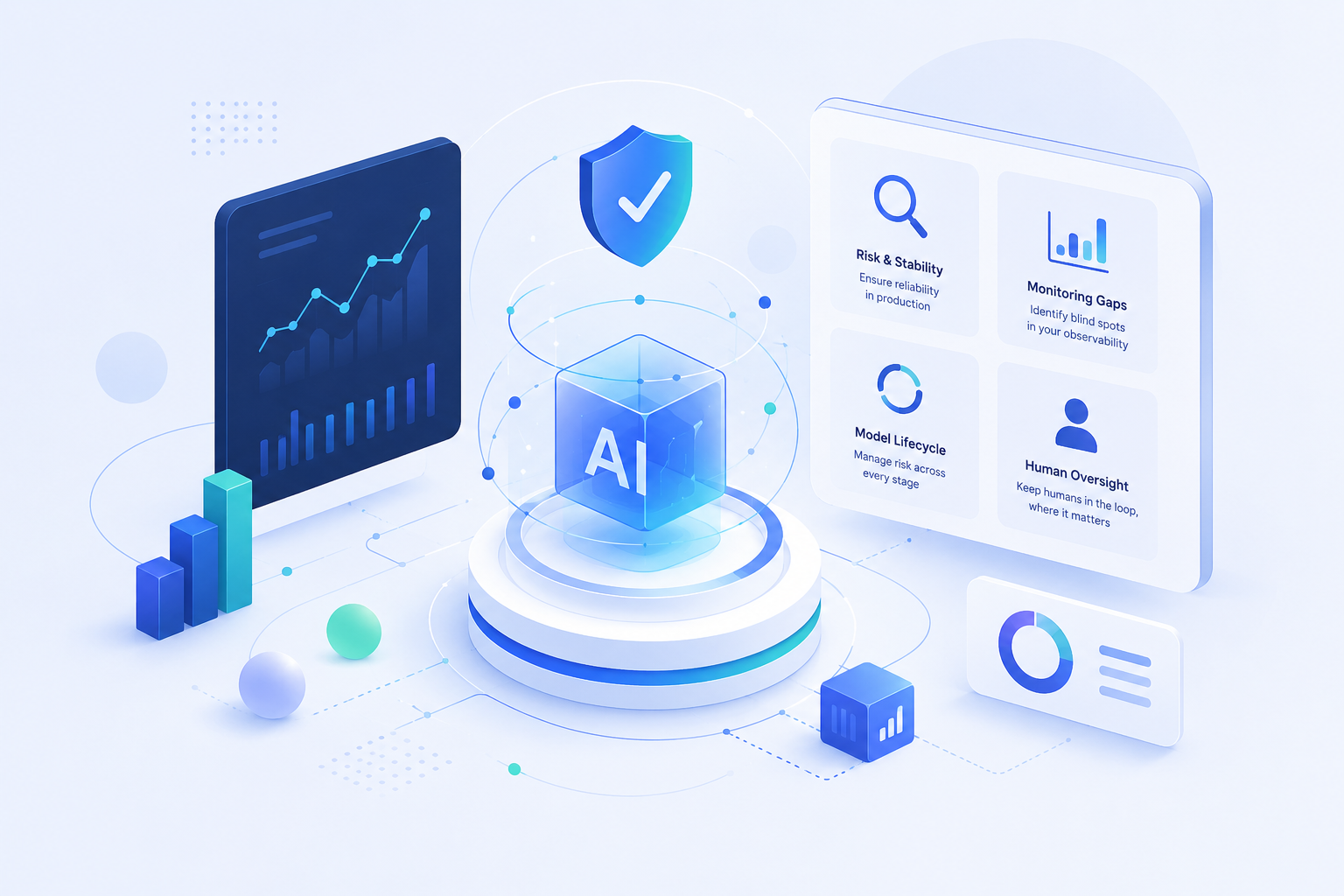
Stage 03 — Early Growth
Seed & Series A AI Startups
Live product with initial users. Scale without stability or reliability risk.
Scaling risks — behaviours acceptable at 100 users create serious problems at 10,000
Inconsistent outputs — no systematic way to catch when your model misbehaves
Lack of monitoring — no alerting, no logging, no ability to detect when something goes wrong
Model update risks — you update your model and something breaks in production with no rollback plan
Production AI Risk & Stability Audit
A comprehensive audit of your AI system in production — reviewing performance consistency, failure rate patterns, demographic performance gaps, output quality monitoring, and stability under load. Risk-rated findings report with remediation priorities.
Monitoring & Logging Gap Analysis
A review of your current monitoring, logging, and alerting infrastructure. We identify what you are not tracking that you should be, and what minimum monitoring infrastructure you need for responsible operation at scale.
Model Lifecycle Risk Assessment
A review of how you manage your AI models across their full lifecycle — selection, deployment, versioning, updating, and retirement. Lightweight model management framework that reduces update risk and maintains accountability.
Human-in-the-Loop Design Review
A review of where human oversight exists — and where it does not — in your AI system. We identify decisions that should have human review and design appropriate controls that do not kill product velocity.
System Architecture Risk Review
A governance-focused review of your AI system architecture — data flows, model integrations, third-party dependencies, and failure cascade risks.
Outcome
Improved reliability and controlled scaling. Visibility into what your AI system is doing, systematic monitoring for when things go wrong, and governance controls that grow with your product.
3–6 weeks depending on system complexity
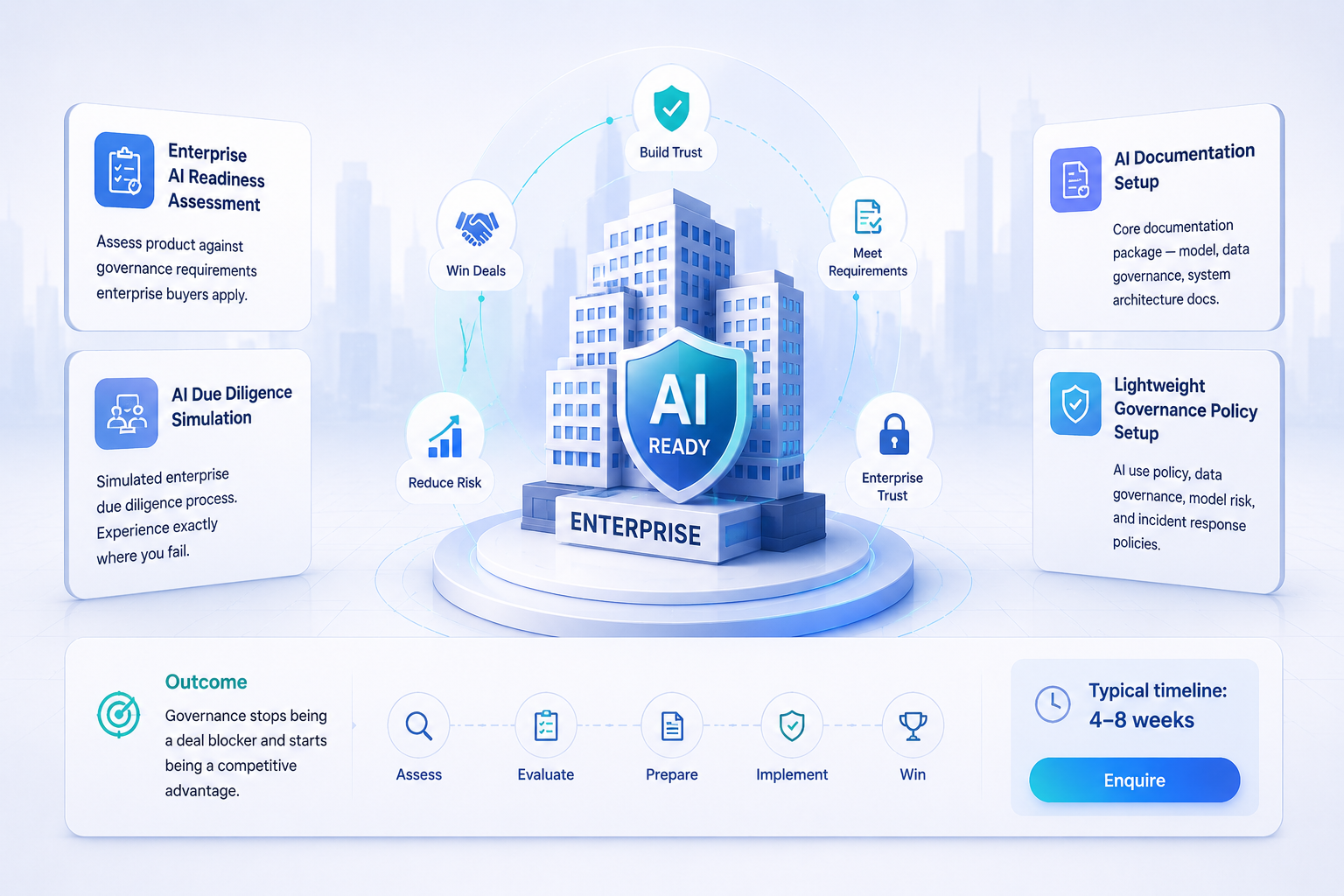
Stage 04 — Enterprise-Bound
Enterprise-Selling AI Startups
Selling to enterprise clients. Stop losing deals to governance questions.
Failing enterprise due diligence — you cannot answer governance, risk, and compliance questions
Security and compliance questionnaires — 40+ question vendor assessments with no answers
Lack of documentation — no risk register, no governance policies, no model documentation
Deal blockers — governance gaps preventing you from closing deals you should be winning
Enterprise AI Readiness Assessment
A structured assessment of your AI product against the governance, security, and compliance requirements enterprise buyers apply. You receive a readiness scorecard — what you pass, what you fail, and the gap-closing work required.
AI Due Diligence Simulation
We put you through a simulated enterprise due diligence process — asking the same questions a sophisticated enterprise buyer or investor would ask. You experience exactly where you fail, and we build a remediation plan.
AI Documentation Setup
Creation of the core AI documentation package enterprise buyers expect — model documentation, data governance documentation, system architecture overview, performance and testing documentation, and limitations disclosure.
Risk Register Creation
Development of a formal risk register covering all identified AI risks — with descriptions, likelihood and impact ratings, current controls, risk owners, and review schedule.
Security & Compliance Gap Analysis
A focused review of your security and compliance posture from an enterprise buyer's perspective. We identify the gaps most likely to surface in vendor assessments and prioritise remediation by commercial impact.
Lightweight Governance Policy Setup
Creation of a core governance policy suite — AI use policy, data governance policy, model risk policy, and incident response policy — tailored to your company size and product.
Outcome
You can answer enterprise governance questions credibly and completely. Governance stops being a deal blocker and starts being a competitive advantage.
4–8 weeks depending on gap size
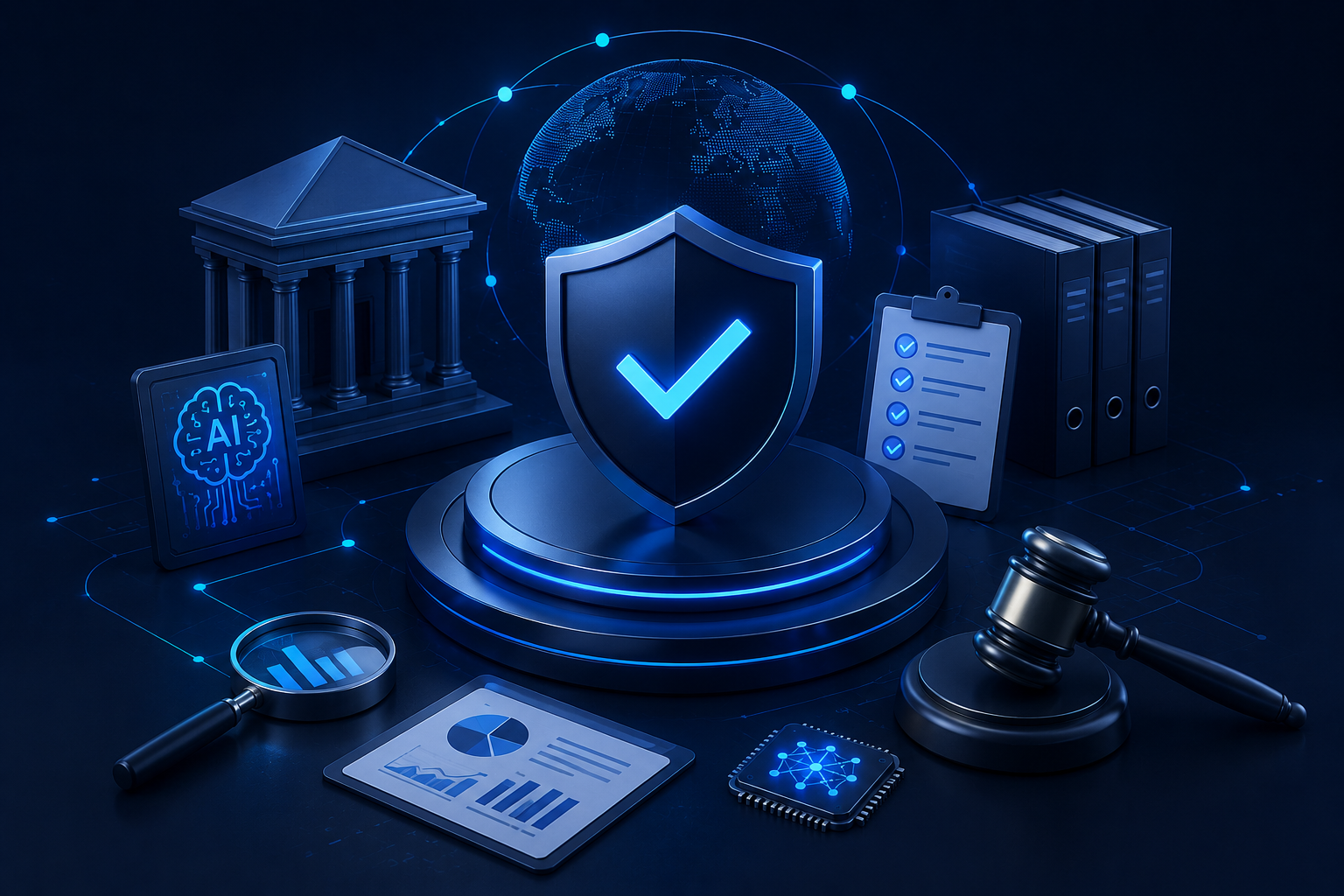
Stage 05 — Scale & Compliance
Scaling & Regulated AI Companies
Operating at scale or entering regulated industries. Full governance and compliance readiness.
Formal compliance requirements — regulations impose specific documented obligations
Audit readiness — need documented evidence of governance for third-party audits
Legal exposure — non-compliance carries real financial and reputational penalties
Governance structure gaps — informal governance no longer sufficient at this scale
AI Governance Framework Implementation
Design and implementation of a complete AI governance framework — governance structure, policies, processes, controls, accountability assignments, and continuous improvement. Built to ISO 42001 standards and aligned with NIST AI RMF.
Regulatory Alignment — EU AI Act
Full compliance alignment with the EU AI Act — risk classification, conformity assessment preparation, required technical documentation, transparency obligations, human oversight requirements, incident reporting, and registration obligations.
AI Risk Management System Setup
Design and implementation of a formal AI Risk Management System — risk identification methodology, assessment processes, treatment procedures, monitoring and review mechanisms, and documentation standards.
Audit Preparation & Support
Preparation for third-party governance audits — documentation review, evidence collection, gap remediation, and support during the audit process.
Explainability & Transparency Setup
Implementation of explainability and transparency requirements — user-facing notices, model explanation documentation, decision audit trails, and explainability testing.
Internal AI Compliance Training
Design and delivery of internal AI compliance training — covering governance framework, regulatory obligations, employee responsibilities, and how to identify and escalate AI governance concerns.
Outcome
Full compliance readiness and structured governance. You can face regulatory scrutiny, third-party audits, and enterprise due diligence with complete confidence.
8–16 weeks depending on scope
Stage 06 — Regulated Sector | Available by Application
Finance, Healthcare & Government AI Companies
Highly regulated environments. Long-term governance partnership and continuous compliance.
Mandatory audits — periodic governance audits required by regulators or contracts
Regulatory reporting — formal reporting obligations to sector regulators
High liability risk — AI failures carry serious legal, financial, and reputational consequences
Continuous compliance — governance is an ongoing operational requirement not a project
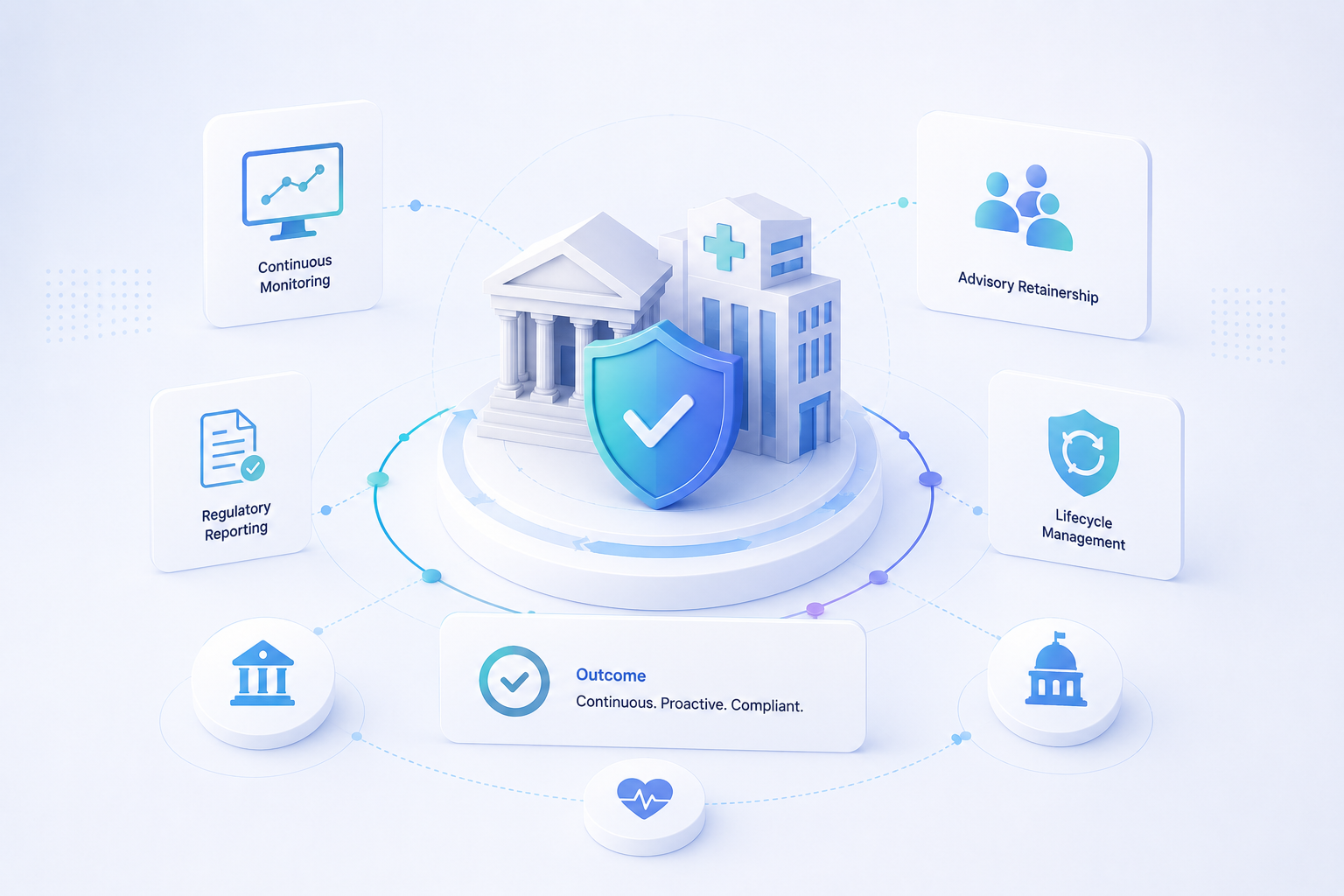
Continuous AI Compliance Monitoring
Ongoing monitoring covering regulatory developments, compliance posture, and emerging risks. Monthly reports, regulatory update briefings, and proactive gap identification.
Regulatory Reporting Support
Support for formal regulatory reporting — preparation of required submissions, incident reporting documentation, performance disclosures, and communication with regulatory bodies.
Third-Party Audit Coordination
Management of third-party AI governance audits — from preparation through evidence submission to findings response and remediation.
Governance Advisory Retainership
Senior governance advisory retainer for strategic decisions, regulatory navigation, incident response, and governance evolution as your business scales.
End-to-End AI Governance Lifecycle Management
Complete ongoing management of your AI governance function — framework maintenance, policy updates, training delivery, audit coordination, regulatory monitoring, and incident management.
Outcome
Long-term governance partnership and compliance sustainability. Your AI governance function operates continuously, proactively, and to the standard your sector requires.
Ongoing — minimum 6-month engagement
FAQ
- How long does each engagement take?
-
It depends on your stage and the complexity of your AI systems. As a guide: Stage 01 idea-stage engagements typically take 1–2 weeks. Stage 02 pre-launch safety reviews take 2–4 weeks. Stage 03 growth audits take 3–6 weeks. Stage 04 enterprise readiness takes 4–8 weeks. Stage 05 full governance framework implementation takes 8–16 weeks. We agree timelines at the start of every engagement based on your specific situation.
- Do you sign NDAs?
-
Yes. We sign a standard mutual NDA before every engagement begins. Your product details, architecture, and data practices are confidential. Nothing leaves the engagement without your explicit consent.
- Do we need to share our code or model weights with you?
-
No. We do not require access to your source code or model weights. Our assessments are conducted through structured documentation reviews, interviews with your technical team, and system behaviour testing. You control what you share with us at all times.
- What if we are between stages or not sure which stage we are at?
-
That is exactly what the free discovery call is for. Most clients are not sure which stage describes them when they first reach out. We ask the right questions, identify your stage, and recommend the right starting point. Book the call and we will work it out together.
- Can you work directly with our technical team?
-
Yes. We work closely with technical teams at every stage. Our assessments involve structured sessions with your engineers, data scientists, and product managers. We do not just talk to founders — we get into the detail with the people building the product.
- What happens after the engagement ends?
-
Every fixed-scope engagement ends with a written deliverable — an audit report, a governance framework, a compliance roadmap, or a documentation package depending on the service. We include a 30-day post-engagement support window for questions about the deliverables. Clients who want ongoing support can move to the Fractional AI Governance Officer retainer or a Stage 06 ongoing engagement.
- We are a very small team — is this relevant for us?
-
Yes — often more so than for larger teams. Small teams move fast and ship fast. The governance gaps that create real problems — unsafe product launches, failed enterprise due diligence, EU AI Act exposure — do not wait until you reach a certain team size. Our Stage 01 and Stage 02 services are specifically designed for small teams and are scoped and priced accordingly.
Not sure which stage describes you?
Book a free 30-minute discovery call. We will identify your stage, your most important governance gaps, and the right starting point.
Recruitment Process
These cases are perfectly simple and easy to distinguish.
- Reducing Redundancy
- Uncovering Hidden Resources
- Increasing Company’s Agility
Recruitment Process
These cases are perfectly simple and easy to distinguish.
Employee Relations
Indignation sed dislike men who are beguiled and demoralized.
- Improving Communication
- Employee issue resolution
- Proper Documentation Process
Employee Relations
Indignation sed dislike men who are beguiled and demoralized.
Compliance Audits
Prevents our being able too what get like best every pleasure.
- Handling of employment
- Greater retention rates
- A fully engaged workforce
Compliance Audits
Prevents our being able too what get like best every pleasure.
Health Care Benefits
The great explorer of the truth the master builders human happiness.
Read moreDenounce with righteous indignation and dislike men who are beguiled and demoralized by the charms of pleasure.
Recruitment Process 48%
Employee Relations 79%
Compliance Audits 65%
Bronze Package
Pricing plan for startup company
149
Loves or pursues or desires obtain pain of itself is pain occasionally.
Silver
Package
Pricing plan for startup company
249
Loves or pursues or desires obtain pain of itself is pain occasionally.
Gold
Package
Pricing plan for startup company
349
Loves or pursues or desires obtain pain of itself is pain occasionally.
Bronze Package
Pricing plan for startup company
349
Loves or pursues or desires obtain pain of itself is pain occasionally.
Silver
Package
Pricing plan for startup company
549
Loves or pursues or desires obtain pain of itself is pain occasionally.
Gold
Package
Pricing plan for startup company
949
Loves or pursues or desires obtain pain of itself is pain occasionally.
Denounce with righteous indignation and dislike men who are beguiled and demoralized by the charms of pleasure.